

Last updated: April 23, 2026
Quick Answer
The best time to visit the Osa Peninsula for wildlife and biodiversity is during the green season (May through November), when rainfall transforms the forest into its most biologically active state, animals move freely without heat stress, and photographic conditions favor diffused light over harsh contrast. While the blue season (December through April) offers easier access and predictable weather, the wet months deliver higher species density, more dynamic animal behavior, and significantly fewer visitors—critical advantages for serious wildlife observation and photography.
Key Takeaways
- Green season (May–November) produces peak wildlife activity due to abundant food sources, cooler temperatures, and reduced heat stress on animals
- Blue season (December–April) provides easier logistics with drier trails and clearer skies, but harsher light and more tourist pressure
- Photographic light quality is superior during wet months when cloud cover creates even, workable illumination throughout the day
- Species like tapirs, peccaries, and forest raptors are more visible during green season when they're not retreating to shade
- Corcovado National Park access remains viable year-round with proper planning and understanding of trail conditions
- Crowd density drops dramatically after April, creating more intimate wildlife encounters and better field positioning
- Humpback whales arrive in two distinct windows: July–November (Southern Hemisphere) and December–April (Northern Hemisphere)
- The Osa Peninsula contains 2.5% of global biodiversity in less than 0.001% of Earth's surface area
- Migratory bird arrivals peak October–November, adding seasonal species to already dense resident populations
- Ethical photography requires seasonal awareness of nesting periods, breeding behavior, and stress indicators
Why the Green Season Deserves Your Attention for Wildlife Photography
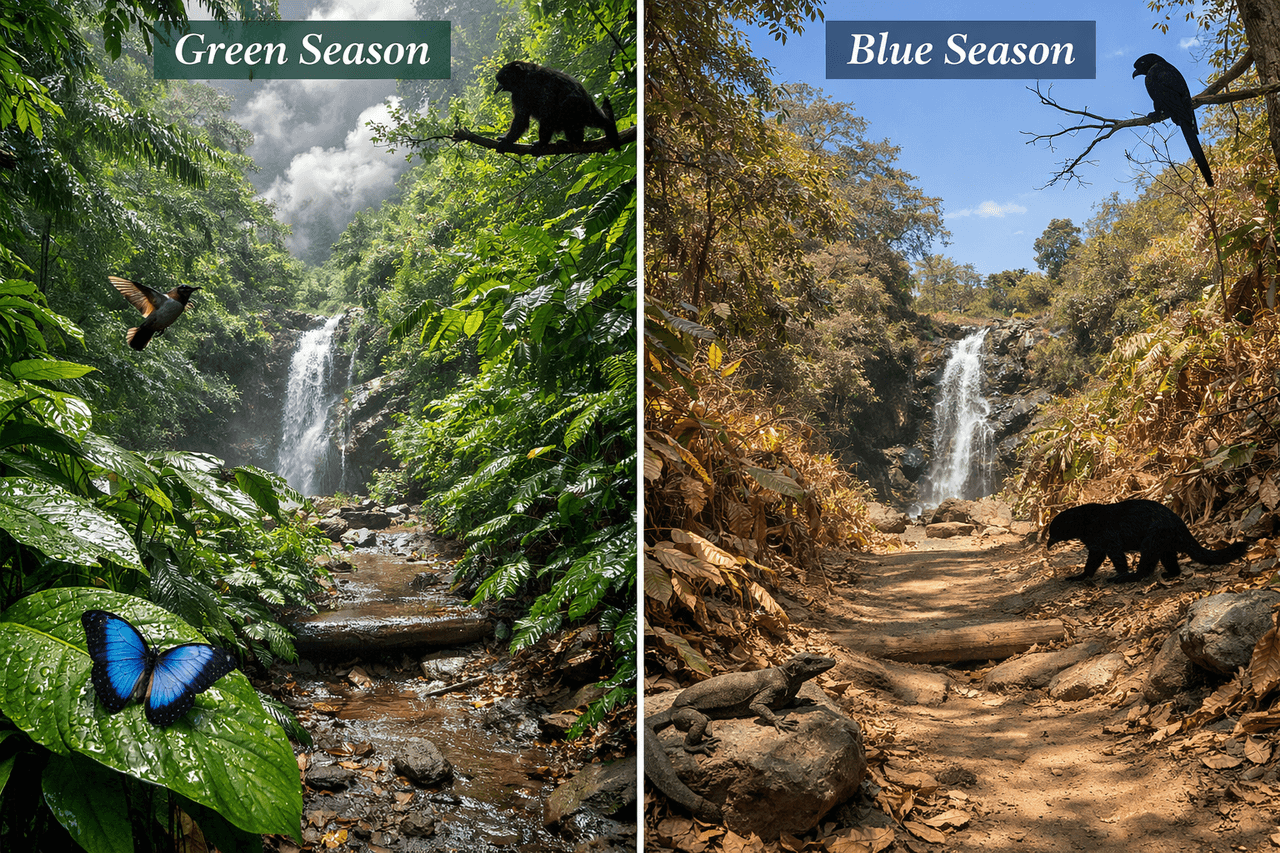
The green season receives less attention in mainstream travel literature, but it represents the Osa Peninsula at its most biologically authentic. From May through November, rainfall patterns trigger reproductive cycles, fruiting events, and migratory arrivals that define this region as one of the most biologically intense places on Earth.
The forest transforms completely. Waterfalls that barely trickle in March roar by June. Dusty trails become navigable mud. The canopy, stressed and pale by late April, explodes into saturated green within weeks. This isn't just aesthetic—it's functional. Fruiting trees produce heavily during wet months, concentrating primates, toucans, and peccaries in predictable feeding zones.
Animal behavior shifts in ways that favor observation. During the blue season's midday heat, mammals retreat into deep shade or become crepuscular. In the green season, cloud cover and cooler air temperatures allow species like Baird's tapir, white-lipped peccaries, and even jaguars to remain active well into late morning and resume earlier in the afternoon. I've watched tapirs feed openly at 11 a.m. in July—something nearly impossible in February.
Photographic conditions improve dramatically. Harsh equatorial sun creates exposure challenges that even experienced shooters struggle with: blown highlights on pale plumage, impenetrable shadows in the understory, extreme contrast ratios that exceed sensor latitude. Overcast skies during the green season function as a massive natural diffuser, delivering workable light from dawn until 4 p.m. Your keeper rate will climb.
The roads aren't as dusty. The foliage is much more green and lush. The waterfalls are flowing. And wildlife is abundantly active, not trying to hide from the scorching sun. It's also much less crowded during the green season—a factor that matters more than most photographers realize until they're competing for tripod space.
Understanding the Blue Season: December Through April
The blue season offers what most travelers prioritize: predictability. Rainfall drops to near zero in many weeks, trails dry out, and access to remote areas of Corcovado becomes straightforward. Sea temperatures hold at 28°C, and daytime highs settle into a consistent 30–32°C range.
This is peak season for a reason. If your trip is short, your flexibility is low, or you're combining the Osa Peninsula with other Costa Rican destinations, the blue season minimizes logistical friction. You won't lose days to impassable roads. You won't need to adjust plans around afternoon storms. Your gear stays dry.
Primate and mammal viewing remains strong, particularly December through February when resident species are highly visible. All four Costa Rican monkey species—howler, spider, capuchin, and squirrel—are active and vocal. Scarlet macaws move predictably between roosting and feeding sites. Coatis forage openly along forest edges.
But there are trade-offs. Light becomes a technical problem. By late morning, the sun is brutal. Shadows go black. Highlights clip. You're working in a two-hour window after dawn and another two before dusk if you want quality light. Midday shooting is possible only in deep forest, and even then, contrast is severe.
Heat stress affects animal behavior. Mammals reduce activity. Birds pant in the canopy. The forest feels quieter. Species are present, but they're not moving, and movement is what creates photographic opportunities.
Tourist density peaks, especially during North American and European holiday windows. Corcovado's daily visitor limits mean you're sharing trails and key observation points. In wildlife photography, that often means someone else gets the shot—or the animal moves off before you're in position.
What Makes the Green Season Exceptional for Biodiversity Observation
The Osa Peninsula doesn't just host wildlife—it concentrates it. With more than 2.5% of the world's biodiversity in a region you can drive across in two hours, species density here exceeds almost anywhere else in the neotropics. The green season amplifies that density through ecological mechanisms that don't operate during dry months.
Fruiting cycles synchronize with rainfall. Trees like the espavel and wild cashew produce heavily from June onward, creating feeding aggregations. I've counted seven species feeding simultaneously in a single fruiting fig: three parrot species, two toucan species, spider monkeys, and a kinkajou. That doesn't happen in March.
Insect emergence explodes. For insectivorous species—motmots, trogons, antshrikes, flycatchers—this is peak foraging season. You'll see more hunting behavior, more aerial sallies, more active movement through the understory. Insects also mean amphibians, and the Osa's frog diversity is staggering. Red-eyed tree frogs, glass frogs, poison dart frogs—all become vocal and visible.
Migratory species arrive. October and November bring masses of raptors: Swainson's hawks, broad-winged hawks, turkey vultures moving south. Endangered great green macaws return in September and October. Shorebirds work the Golfo Dulce coastline. The resident species list is extraordinary; add migrants and the daily count climbs into triple digits.
Reproductive behavior peaks. Many species time breeding to wet season abundance. You'll encounter nesting activity, juvenile animals, courtship displays. This is when the forest is most alive, most dynamic, most itself.
Does it rain? Yes. Usually in the afternoon. Usually for an hour or two. Rarely all day unless you're in the heart of September or October. And when it does, you take cover, review your morning's work, and prepare for the post-rain activity surge that reliably follows.
How Seasonal Timing Affects Key Species and Photographic Opportunities
Certain species and behaviors are locked to seasonal windows. If your primary interest is a specific animal or event, timing becomes non-negotiable.
Humpback whales: Two populations use Golfo Dulce. Southern Hemisphere whales arrive July through November; Northern Hemisphere whales December through April. For whale photography from boats or coastal vantage points, plan accordingly. The southern population often includes more mothers with calves.
Sea turtles: Leatherbacks nest February through April on beaches near Matapalo and Carate. Olive ridleys nest July through December. Green turtles peak in August. If turtle photography is a priority, align your dates with nesting activity and work with ethical guides who understand approach distances and lighting restrictions.
Scarlet macaws: Resident year-round, but nesting occurs January through April. During this window, pairs are more territorial and vocal, and you'll see adults returning to nest cavities. Post-fledging (May onward), family groups move more widely, often easier to locate and photograph.
Tapirs: More visible during green season when they're not heat-stressed. They frequent streams and wallows, especially early morning and late afternoon. In blue season, they're largely nocturnal.
Big cats: Jaguars and pumas are present year-round but are cryptic and rare. Your best odds are hiring a guide with current knowledge of territory and fresh sign. Season matters less than local intelligence and time in the field.
Resplendent quetzals: Rare on the Osa but present in higher-elevation zones near the peninsula's interior. Breeding season (March–June) increases visibility as males display and vocalize.
Practical Field Conditions: What to Expect in Each Season
Understanding conditions on the ground—trail surfaces, humidity, gear requirements, physical demands—shapes what you can accomplish and how you'll work.
Blue Season Field Conditions
- Trails: Dry, firm, dusty. Easier footing but dust coats gear and gets into camera bodies if you're not careful.
- Stream crossings: Low water. Most crossings are simple.
- Humidity: Lower but still 70–80%. Gear doesn't fog as aggressively.
- Insects: Moderate. Mosquitoes and no-see-ums present but not overwhelming.
- Clothing: Lightweight, breathable. Sun protection critical.
- Footwear: Trail runners or light hiking boots sufficient for most areas.
Green Season Field Conditions
- Trails: Muddy, slippery, occasionally waterlogged. Roots and rocks become hazards. Slower pace required.
- Stream crossings: High water. Some crossings require wading or rerouting. Waterproof bags essential.
- Humidity: 85–95%. Constant. Gear fogs when moving between environments. Silica packs and lens cloths are critical.
- Insects: High. Mosquitoes, biting flies, chiggers. Repellent and treated clothing necessary.
- Clothing: Quick-dry synthetics. Rain jacket always accessible. Extra socks.
- Footwear: Waterproof hiking boots or rubber boots. Your feet will get wet regardless; prioritize traction and support.
Gear protection becomes non-negotiable in the green season. Rain covers for camera bodies and lenses. Dry bags for electronics. Waterproof cases for anything that can't tolerate moisture. I use a pack cover and line the interior with a trash compactor bag—cheap, effective, and lighter than proprietary solutions.
Battery performance drops in high humidity. Bring extras. Memory cards can fail if moisture gets into contacts; keep spares in sealed bags with desiccant.
The physical demand is higher during green season. Trails are slower. You'll work harder for the same distance. But the reward is fewer people, better animal activity, and superior light.
Best Time to Visit the Osa Peninsula for Wildlife Photography: A Month-by-Month Breakdown
December – February: Peak Blue Season
Driest months. Highest tourist numbers. Excellent primate and bird activity in early morning and late afternoon. Harsh midday light. Leatherback turtle nesting begins in February. Humpback whales (Northern Hemisphere population) present. Good for first-time visitors prioritizing logistics over conditions.
March – April: Late Blue Season
Still dry, but temperatures climb. April sees occasional afternoon storms as the transition begins. Crowds thin slightly after Easter. Scarlet macaw fledglings appear. Last reliable window for dry trail access to remote Corcovado zones. Light remains challenging.
May – June: Early Green Season
Rainfall increases but isn't yet heavy. Forest greens up rapidly. Fruiting begins. Animal activity surges. Crowds drop significantly. Excellent balance of access and conditions. This is my preferred window for workshops—logistics are still manageable, but the forest is alive.
July – August: Mid Green Season
Consistent afternoon rains. Trails muddy but passable with proper footwear. Humpback whales (Southern Hemisphere population) arrive. Green turtle nesting peaks in August. Insect diversity at its highest. Photographic light is superb throughout the day. Fewer visitors. This is the Osa at full intensity.
September – October: Peak Green Season
Heaviest rainfall. Some unpaved roads may become impassable without 4WD. Corcovado access requires more planning. Migratory raptors and great green macaws arrive. Species density peaks. Not for beginners, but if you can handle the conditions, this is when the forest delivers its most dramatic encounters. Ethical guides with current trail knowledge are essential.
November: Late Green Season
Rainfall begins to taper. Trails start drying. Migratory birds still present. Excellent compromise month—you get green season biology without peak wet season logistics. Crowds remain low. Highly recommended for serious photographers.
How to Choose Between Seasons Based on Your Priorities
Choose the blue season if:
- This is your first visit to the Osa Peninsula
- Your trip is short (less than five days)
- You're combining the Osa with other Costa Rican destinations
- You have limited flexibility with dates
- You prefer predictable weather and easier logistics
- You're traveling with non-photographers who prioritize comfort
Choose the green season if:
- You're a serious wildlife or bird photographer
- You want fewer crowds and more intimate encounters
- You understand and can manage muddy trails and wet gear
- You prioritize animal behavior and photographic light over convenience
- You're willing to adjust plans based on conditions
- You want to see the Osa Peninsula at its most biologically authentic
Choose shoulder months (May, June, November) if:
- You want the best of both seasons
- You need some logistical predictability but want better light and activity
- You're planning a workshop or guided trip where flexibility exists
- You want lower crowds without peak wet season challenges
There's no wrong choice, but there is a choice that aligns with your goals. I've guided photographers in both seasons, and the ones who thrive in the green season are those who understand that discomfort and reward often correlate in wildlife photography.
What About Crowds and Tourism Pressure During Each Season?
Corcovado National Park limits daily visitors to protect the ecosystem, but those limits are reached regularly during blue season, especially December through March. You'll share trails, observation points, and key wildlife areas with other groups.
In wildlife photography, this matters. Animals habituate to human presence to a degree, but they also alter behavior. A tapir that tolerates one quiet observer may move off when a group of ten arrives. A troop of spider monkeys feeding in a fruiting tree will shift deeper into the canopy if multiple groups position below.
The green season changes this dynamic completely. I've spent entire days in Corcovado during July and August encountering only one or two other groups. That means you control your pace, your positioning, and your time with subjects. You're not competing for angles. You're not waiting for someone else to finish. You're working the way wildlife photography is meant to be worked: patiently, quietly, on the animal's terms.
Puerto Jiménez, the primary gateway town, also feels different. During blue season, it's busy—restaurants full, lodges booked, rental vehicles scarce. In green season, it's quieter, more local, more itself. You'll have better access to guides, easier logistics, and often better rates.
For photographers who value solitude and immersion, the green season isn't just preferable—it's essential.
Understanding Light, Weather Patterns, and Photographic Conditions
Light is the medium. In the Osa Peninsula, it's also the variable that most dramatically separates the seasons.
Blue season light: Hard, contrasty, equatorial. Sunrise is around 5:30 a.m., and by 7:30 a.m., the sun is high and harsh. The golden hour is brief. Midday shooting in open areas is nearly impossible without fill flash or reflectors. Shadows under the canopy go black. Dynamic range exceeds what most sensors can capture cleanly. You're working in narrow windows.
Green season light: Diffused, even, workable. Cloud cover acts as a massive softbox. You can shoot effectively from 6 a.m. until 4 p.m. Contrast is manageable. Colors saturate without blowing out. Shadows retain detail. This is the light that makes National Geographic images possible—not because it's dramatic, but because it's controllable.
Rain typically arrives mid-afternoon during green season, often between 2 and 4 p.m. It's rarely an all-day event except during September and October. Morning shoots are usually dry. The post-rain period, from late afternoon into dusk, is magic. Animals emerge, the air clears, and if the clouds break, you get warm light on wet foliage—one of the most beautiful conditions in nature photography.
Weather predictability: Blue season is highly predictable. You'll have sun. Green season requires flexibility. Some days it rains lightly in the morning. Some days it holds off until evening. Some days in September, it rains hard for hours. You adapt. That's fieldcraft.
For photographers used to temperate zones, the green season will feel familiar in terms of light quality. For those who've only shot in tropical dry seasons, it will be revelatory.
Ethical Wildlife Photography Practices in the Osa Peninsula
The Osa Peninsula's biodiversity is its defining feature, and that biodiversity depends on minimally disturbed habitat and animal behavior. Ethical photography isn't optional—it's the baseline.
Distance matters. Use long lenses (400mm minimum for mammals, 600mm preferred). Don't approach animals to "get closer." If an animal alters its behavior because of your presence—stops feeding, vocalizes alarm, moves away—you're too close.
Nesting and denning sites are off-limits. If you locate a nest, burrow, or den, observe from extreme distance or move on. Repeated disturbance can cause abandonment. This is especially critical during blue season when scarlet macaws and other species are nesting.
No playback. Using recorded calls to lure birds or mammals is unethical and illegal in many protected areas. It stresses animals, disrupts territorial behavior, and wastes their energy.
Stay on trails. Corcovado and other protected areas have designated trails for a reason. Off-trail movement damages understory vegetation and disturbs ground-nesting species.
Work with certified guides. Local guides understand animal behavior, know current territory and activity patterns, and can position you ethically. They also provide context that improves your work. I've never regretted hiring a guide; I've often regretted trying to work alone in unfamiliar terrain.
Respect closures and restrictions. Some areas close seasonally to protect nesting or breeding activity. Follow those closures. Your photograph is not worth disrupting a reproductive cycle.
The Osa Peninsula offers extraordinary access to wildlife, but that access is a privilege. Treat it accordingly.
How to Plan Your Visit: Logistics, Access, and Preparation
Getting There
Fly into San José (SJO). From there, you have two options: a domestic flight to Puerto Jiménez (PJZ) on SANSA or Nature Air (35 minutes), or a six-hour drive. The flight is worth it. The drive is long, and the final stretch on the Interamericana and then down to Puerto Jiménez is slow.
Lodging
Puerto Jiménez is the primary base. It offers a range of lodging from budget to mid-range. For proximity to Corcovado's Los Patos or San Pedrillo entrances, consider lodges near Carate or Drake Bay. Book well in advance during blue season; green season offers more availability.
Guides and Access
Corcovado requires a certified guide for entry. You cannot enter independently. Hire guides through established operators in Puerto Jiménez or through your lodge. For serious photography, book private guides or small-group trips (maximum four people). Larger groups move too quickly and create too much disturbance.
Gear
- Camera body: Weather-sealed preferred. Bring a backup.
- Lenses: 100-400mm or 150-600mm for wildlife. 24-70mm for environmental shots. Macro lens if you're interested in herps and insects.
- Support: Tripod or monopod. A lightweight carbon fiber tripod is ideal for muddy trails.
- Protection: Rain covers, dry bags, silica gel packs, lens cloths.
- Clothing: Neutral colors (greens, browns, tans). No bright colors or noisy fabrics. Quick-dry everything.
- Footwear: Waterproof boots for green season. Trail runners for blue season.
- Accessories: Headlamp, insect repellent (30% DEET minimum), sunscreen, water purification, first aid kit.
Physical Fitness
Corcovado trails are not technical, but they're humid, uneven, and long. A typical day involves 8–12 kilometers of walking, often in heat and mud. Moderate fitness is required. If you're unsure, train beforehand.
Permits and Fees
Corcovado charges park entrance fees (around $15–20 USD per day). Your guide will handle permits, but confirm this when booking.
FAQ: Best Time to Visit the Osa Peninsula for Wildlife and Biodiversity
When is the absolute best month to visit the Osa Peninsula for wildlife photography?
May, June, or November offer the best balance of access, light, animal activity, and low crowds. July and August are ideal if you can manage wet conditions.
Is the green season really better for wildlife, or is that just marketing?
It's genuinely better for wildlife activity, photographic light, and species diversity. The trade-off is logistics and comfort, not wildlife quality.
Can I visit Corcovado during the rainy season?
Yes. The park remains open, though some trails may close temporarily after heavy rain. Work with a guide who monitors current conditions.
What's the worst month to visit the Osa Peninsula?
There's no "worst" month, but September and October present the most logistical challenges due to heavy rain. March and April offer the harshest light.
Do I need a 4WD vehicle?
During blue season, a standard car works for most areas. During green season, 4WD is strongly recommended, especially for reaching trailheads outside Puerto Jiménez.
How crowded is Corcovado during peak season?
Daily visitor limits prevent overcrowding, but you'll share trails with other groups. Early entry (6 a.m.) helps, as does visiting during green season.
What wildlife can I expect to see in the Osa Peninsula?
All four monkey species, scarlet macaws, toucans, trogons, motmots, coatis, agoutis, peccaries, tapirs (with luck), sloths, poison dart frogs, caimans, and an extraordinary diversity of insects and birds. Jaguars and pumas are present but rarely seen.
Is it safe to visit during the rainy season?
Yes, with proper preparation. Trails are slippery, and stream crossings can be challenging, but the risks are manageable with good footwear, awareness, and a knowledgeable guide.
What's the temperature like year-round?
Daytime highs are consistently 28–32°C (82–90°F). Nights cool slightly to 22–24°C (72–75°F). Humidity is the bigger factor, ranging from 70% in blue season to 95% in green season.
Can I see both whales and nesting turtles in one trip?
Yes, if you visit in February, March, or April (Northern Hemisphere humpbacks and leatherback turtles) or in July and August (Southern Hemisphere humpbacks and green turtles).
How far in advance should I book?
For blue season, book lodging and guides at least three months ahead. For green season, six weeks is usually sufficient, though popular lodges and specialized guides fill early.
What's the best way to photograph in high humidity?
Keep gear in sealed bags with silica gel when not in use. Allow lenses to acclimate before shooting to prevent internal fogging. Carry microfiber cloths and use lens hoods to shed rain.
Conclusion: Choosing Your Window into the Most Biologically Intense Place on Earth
The best time to visit the Osa Peninsula for wildlife and biodiversity isn't a single month or a narrow window—it's the season that aligns with what you value as a photographer and observer. If you prioritize ease, predictability, and dry trails, the blue season delivers. If you prioritize light, animal behavior, solitude, and the forest at its most alive, the green season is unmatched.
I've worked both seasons extensively, and my preference is clear: give me May through November. Give me the diffused light, the active animals, the empty trails, and the forest in full voice. Yes, my boots get muddy. Yes, I pack more gear protection. But the images I bring back—and the encounters I experience—justify every bit of discomfort.
The Osa Peninsula holds 2.5% of the world's biodiversity in a space you can explore in a week. That concentration is rare, precious, and worth experiencing on its own terms. Whether you come in February or July, you'll leave understanding why National Geographic called this region "the most biologically intense place on Earth."
Ready to plan your visit? Start by defining your primary goals—species, behavior, or photographic style—and then match those goals to seasonal conditions. Work with local guides who know current animal movements and trail status. Pack for the season you've chosen, not the season you wish you had. And when you're standing in the forest at dawn, watching a troop of spider monkeys move through the canopy or a tapir emerge from the understory, you'll know you timed it right.
The Osa Peninsula doesn't perform for visitors. It simply exists, in all its complexity and intensity. Your job is to show up when the conditions align with your vision—and then let the forest do what it's been doing for millennia.